Waking up lots at night to use the toilet? Most men blame the prostate first, and fair enough. Prostate cancer is the most commonly diagnosed cancer in Australian men, with an estimated 28,868 new cases in 2025, according to Cancer Australia. [1] This Movember, it is worth knowing the prostate is not the only possible cause of nightly wakings. Untreated sleep apnoea is a well-documented and often overlooked reason for nocturia, the medical term for waking at night to pass urine.
Check your prostate first
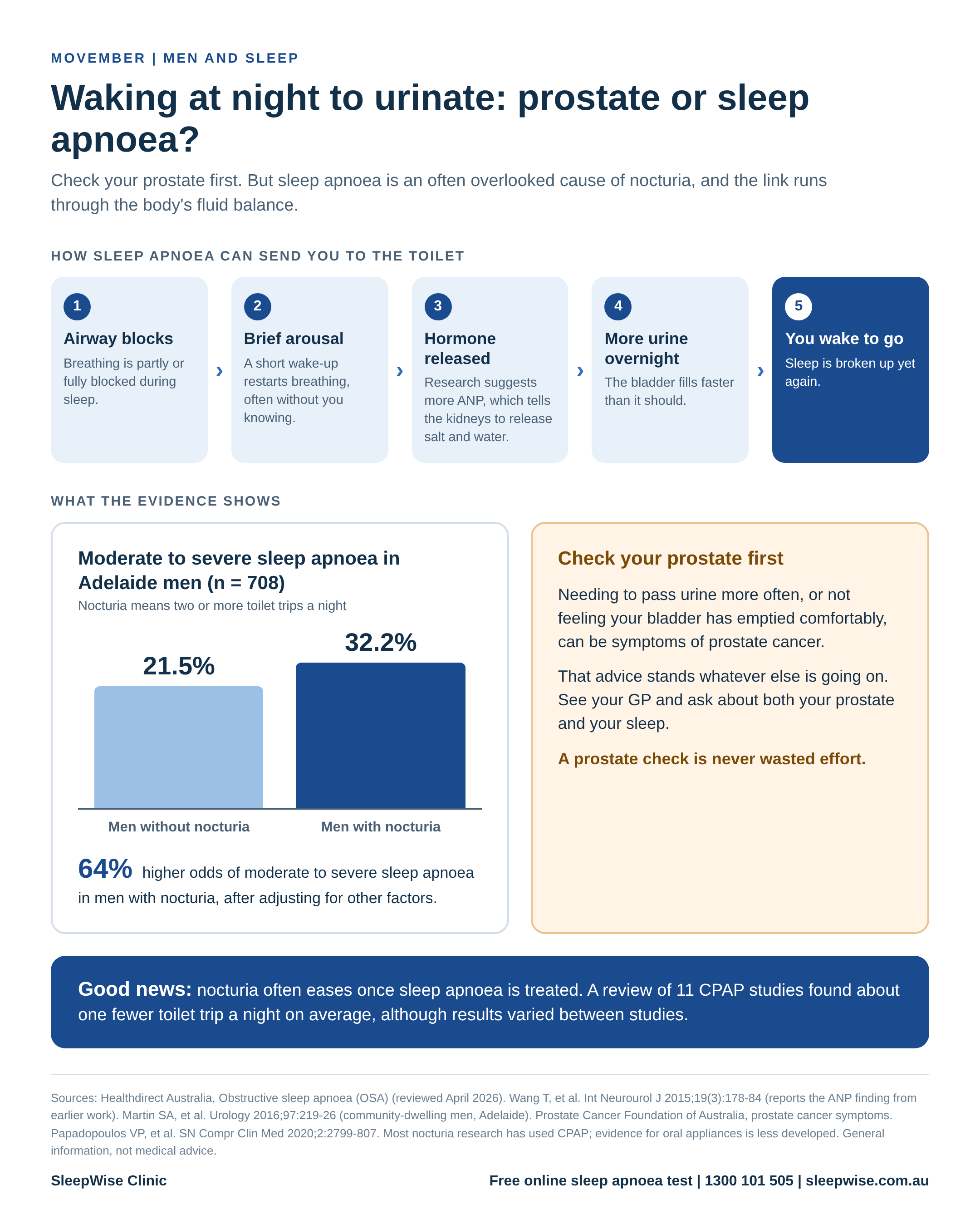
Needing to pass urine more often, or not feeling that your bladder has emptied comfortably are common symptoms of prostate cancer, and the Prostate Cancer Foundation of Australia encourages men who notice this to see their GP.[2] That advice stands regardless of whatever else is going on, and a prostate check is never a wasted effort. Survival has also improved considerably, with five-year relative survival rising from 60% in 1987 to 1991 to 96% in 2017 to 2021, which is a good reason not to put off a check.[1]
How sleep apnoea sends you to the bathroom
In obstructive sleep apnoea, the airway is partly or completely blocked at times during sleep, and each blockage ends with a brief arousal that restarts breathing again, often without you being aware of it, as Healthdirect explains.[3] Research suggests these repeated blockages change how the body handles fluid. People with sleep apnoea have been reported to produce more urine overnight and to excrete more atrial natriuretic peptide (ANP), a hormone that tells the kidneys to release salt and water.[4] The bladder fills faster than it should, and a man wakes to use the toilet without ever connecting it to his breathing. Every trip also breaks up sleep that is already being disrupted.
What Australian research shows
A study of 708 community-dwelling men in Adelaide, none with a prior sleep apnoea diagnosis and none with prostate or bladder cancer, defined nocturia as two or more toilet trips a night and found it was associated with moderate to severe sleep apnoea, with 64% higher odds after adjusting for other factors.[5] Moderate to severe sleep apnoea was present in 32.2% of men with nocturia, compared with 21.5% of men without it.[5] The more often men woke to urinate, the less time they spent in REM sleep and in Stage N2 sleep, the lighter stage that made up about 45% of their sleep.[5] The toilet trips, in other words, are often one piece of a broader pattern of disrupted sleep.
Treating the airway can settle the bladder
The encouraging news is that nocturia often eases once sleep apnoea is treated. A systematic review of CPAP trials found significant reductions in both the number of nocturia episodes and the volume of urine passed [4], and a later review of 11 studies covering 830 patients found nocturia fell by about one episode a night after CPAP was started, although results varied considerably between studies.[6]
Most of this research has used CPAP, so the evidence for oral appliances in this space specifically is a little behind. However, mandibular advancement splints are now described as the leading alternative to CPAP, and they work by holding the lower jaw forward to open the airway.[7] It is plausible that this helps the bladder too, but it still needs testing, though early signs are promising. A US dental team reported at a 2021 conference that more than half of their patients treated with a splint no longer had nocturia by their third follow-up visit [8], and a trial designed specifically to test whether splint use reduces nocturia is now under way.[9] The report is a conference abstract and not a full published trial, so it is a signal of things to come.
What we do know is that a splint is a credible treatment for the sleep apnoea itself. The FLOSAT study followed 94 adults with moderate to severe sleep apnoea who used a splint for three months and then CPAP for another three months. In the study, the splint was tested against a simple question: is it clearly worse than CPAP? The researchers used an overall score, called mean disease alleviation, that combines how well a treatment controls sleep apnoea with how much people actually use it. The splint scored about the same as CPAP, so it was judged to be non-inferior. [10] In plain terms, the splint held its own against CPAP. CPAP controlled breathing interruptions better, but the splint was worn for longer each night, and that evened out the overall score. [10] The study came about by chance. The 2021 Philips CPAP recall left patients waiting for replacement machines, so participants were able to trial the splint first. The authors caution that the score has not yet been tested against how patients actually feel and fare, so it does not prove the two treatments work equally well.[10] Even so, it is an encouraging step, and the researchers are calling for larger studies.[10]
Australian guidance recognises oral appliances too. The Royal Australian College of General Practitioners lists mandibular advancement devices as an option for mild to moderate sleep apnoea, and for moderate to severe sleep apnoea when CPAP is not tolerated, and notes that for mild to moderate sleep apnoea their efficacy is comparable to CPAP.[11]
What to do next
If waking to urinate is a regular part of your nights, see your GP and ask for both a prostate check and a conversation about sleep apnoea, particularly if you also snore, wake unrefreshed or feel tired through the day. Your GP will ask about snoring and any breathing pauses a bed partner has noticed, so it helps to ask the person you share a bedroom with what they have seen and heard.[12] If a sleep study confirms sleep apnoea, our sleep medicine dentists at SleepWise Clinic can assess whether a custom oral appliance suits you.
This Movember, treat the nightly trips as a reason to book the appointment you have been putting off. Call 1300 101 505 or take our free online sleep apnoea test to get started.
References1. Cancer Australia. Prostate cancer statistics [Internet]. [cited 2026 Nov 8]. Available from: https://www.canceraustralia.gov.au/cancer-types/prostate-cancer/statistics2. Prostate Cancer Foundation of Australia. Prostate cancer symptoms [Internet]. [cited 2026 Nov 8]. Available from: https://www.prostate.org.au/risk-and-symptoms/symptoms/3. Healthdirect Australia. Obstructive sleep apnoea (OSA) [Internet]. [reviewed 2026 Apr; cited 2026 Nov 19]. Available from: https://www.healthdirect.gov.au/obstructive-sleep-apnoea4. Wang T, Huang W, Zong H, Zhang Y. The efficacy of continuous positive airway pressure therapy on nocturia in patients with obstructive sleep apnea: a systematic review and meta-analysis. Int Neurourol J. 2015;19(3):178-84. 5. Martin SA, Appleton SL, Adams RJ, Taylor AW, Catcheside PG, Vakulin A, et al. Nocturia, other lower urinary tract symptoms and sleep dysfunction in a community-dwelling cohort of men. Urology. 2016;97:219-26. 6. Papadopoulos VP, Apergis N, Filippou DK. Nocturia in CPAP-treated obstructive sleep apnea patients: a systematic review and meta-analysis. SN Compr Clin Med. 2020;2:2799-807. 7. Mohammadieh A, Tong B, De Chazal P, Cistulli PA. Innovations in mandibular advancement splint therapy for obstructive sleep apnoea. Front Sleep. 2023;2:1144327. 8. Yanez-Regonesi F, Sangalli L, Martinez-Porras A, et al. Improvement in nocturia in obstructive sleep apnea patients with the use of mandibular advancement device. J Dent Sleep Med. 2021 Virtual Annual Meeting Abstracts: abstract 13.9. ClinicalTrials.gov. Mandibular advancement device and changes in nocturia (NCT05562388) [Internet]. [cited 2026 Nov 19]. Available from: https://clinicaltrials.gov/study/NCT0556238810. Dieltjens M, Engelen S, Azarbarzin A, Van den Bossche K, Van Loo D, Braem MJ, et al. Comparative effectiveness of oral appliances and continuous positive airway pressure: a prospective non-randomized study using a non-inferiority framework. Am J Respir Crit Care Med. 2026;aamag388.11. Royal Australian College of General Practitioners. Mandibular devices for obstructive sleep apnoea. In: HANDI: Handbook of Non-Drug Interventions [Internet]. [cited 2026 Nov 19]. Available from: https://www.racgp.org.au/clinical-resources/clinical-guidelines/handi/handi-interventions/other/mandibular-devices-for-obstructive-sleep-apnoea12. Australasian Sleep Association. Obstructive sleep apnoea: GP guideline [Internet]. 2024 [cited 2026 Nov 19]. Available from: https://sleep.org.au/common/Uploaded files/Public Files/Resources/GP fact sheets/ASA Obstructive Sleep Apnoea-GP Guideline-040624.pdf