
Men see doctors less often than women, and many wait before they go. According to The Medical Republic, only 78% of men saw a GP, compared with 87% of women, and Movember’s 2024 Real Face of Men’s Health report found that 60% of men would wait more than a week with symptoms before seeing a doctor.¹ With snoring and sleep apnoea, waiting matters, because the condition is easy to miss and often goes undiagnosed. This Movember, here is why men put it off and what a simple first step looks like.
Why men wait
Movember’s 2024 report found that more than half of men believe it is normal for men to avoid regular health check-ups, as summarised by Life in Mind.² It also found that 63% of men felt stereotypes of stoicism had affected their health behaviours.¹ Age matters as well. A national survey of 1,282 Australian men, published in 2025, found that men aged 18 to 29 had markedly lower odds than men aged 70 and over of preferring professional help for a physical health problem (odds ratio 0.28), and that 32% of the younger men reported three or more practical barriers to care, compared with 9.3% of men over 70.³ These findings are about physical health in general, but snoring is exactly the kind of symptom that is easy to leave alone.
Snoring is easy to shrug off
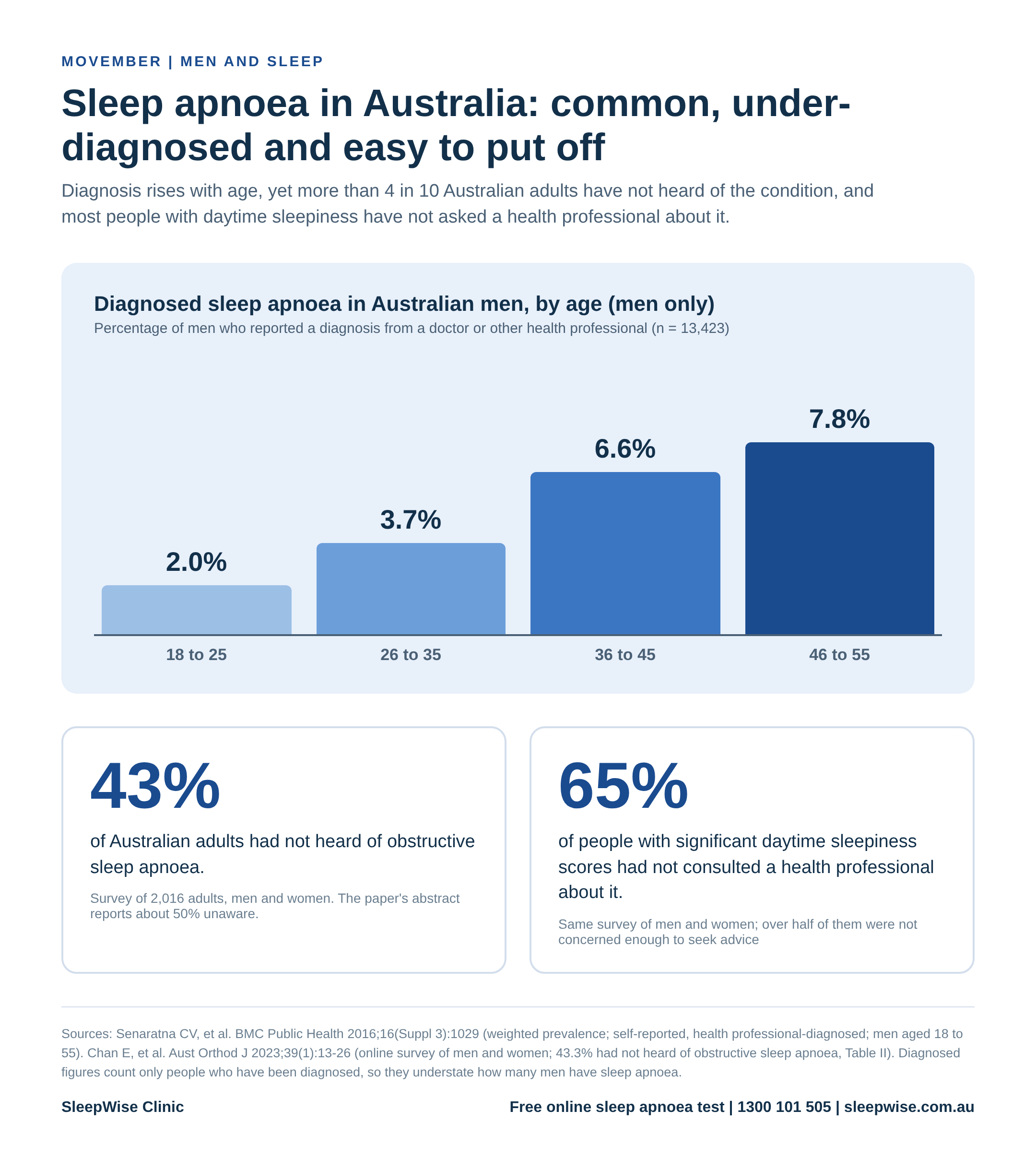
Snoring and tiredness are easy to put down to age, stress or a busy job. Yet sleep apnoea is common in Australian men. A national study of 13,423 men aged 18 to 55 found that self-reported, health professional-diagnosed sleep apnoea rose from about 2% in men aged 18 to 25 to 7.8% in men aged 46 to 55, and those figures count diagnosed cases only.⁴ Men with sleep apnoea also reported poorer physical, mental and self-rated health, lower wellbeing and more difficulty concentrating or remembering than men without it.⁴ Awareness is low as well. In an online survey of 2,016 Australian adults published in 2023, 43% had not heard of obstructive sleep apnoea, and 65% of people with significant daytime sleepiness scores had not consulted a health professional, with over half of them not concerned enough to seek advice.⁵
Partners often notice first
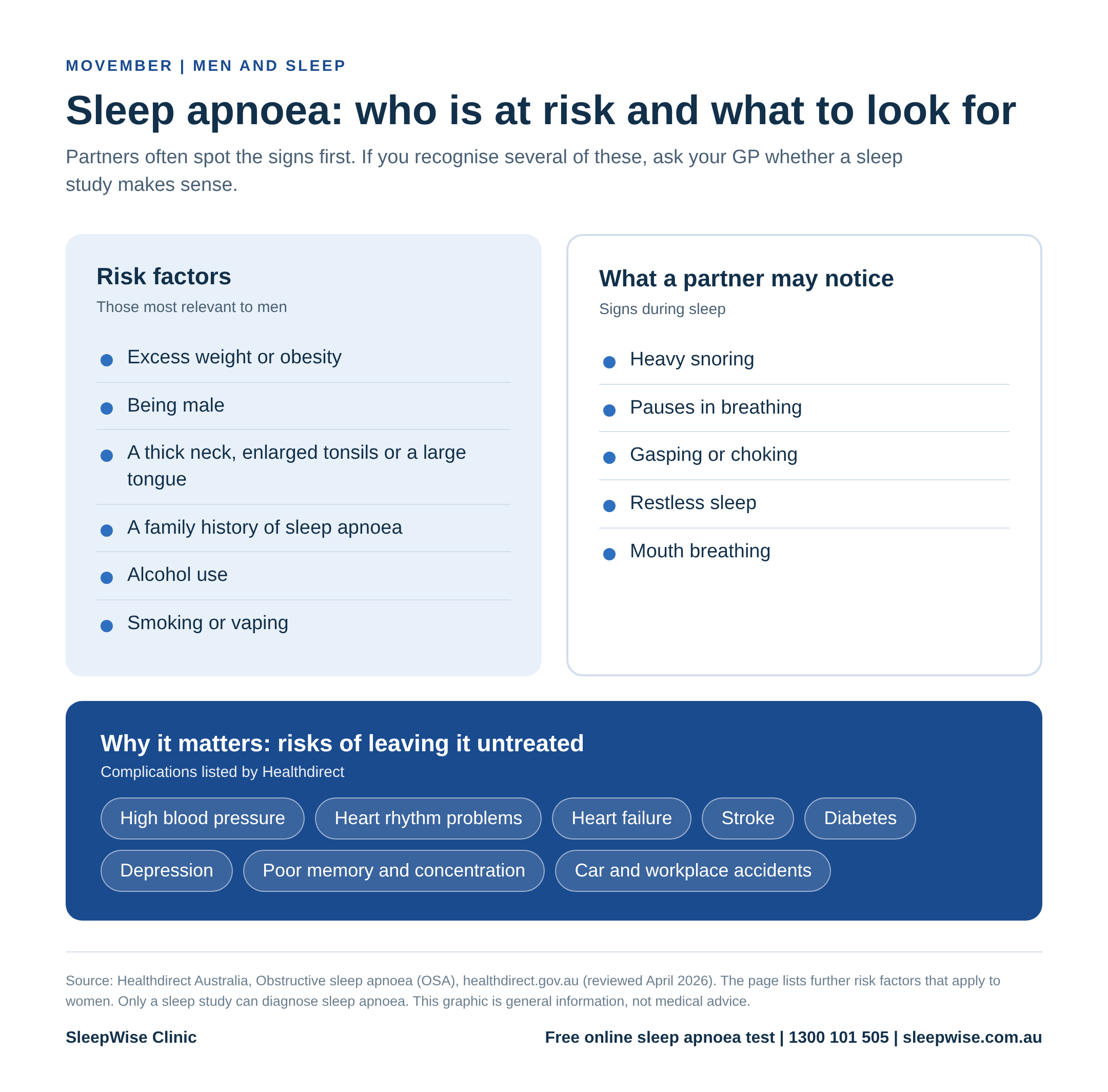
Frequently the person raising the alarm is the one lying next to him. The Australasian Sleep Association’s GP guideline lists snoring, witnessed breathing pauses and waking gasping or choking among the symptoms GPs ask about⁶, so it helps to ask the person you share a bedroom with what they have seen and heard. Healthdirect names excess weight, being male, a thick neck, a family history of sleep apnoea, alcohol use and smoking or vaping among the risk factors.⁷ Left untreated, sleep apnoea raises the risk of high blood pressure, heart rhythm problems, heart failure, stroke and diabetes, and Healthdirect also lists depression, poor memory and concentration, and a higher risk of car and workplace accidents.⁷
A simple first step
You do not need to have it all worked out before you act. Start with your GP and ask whether a sleep study makes sense for you. The Royal Australian College of General Practitioners lists mandibular advancement devices as an option for mild to moderate sleep apnoea, and for moderate to severe sleep apnoea when CPAP is not tolerated.⁸ Mandibular advancement splints are now described as the leading alternative to CPAP, and the case for them rests partly on adherence, because CPAP acceptance and compliance can be low and a dental splint may be easier to keep using.⁹ For a wider look at what helps with snoring, read our two-part guide: What treatments are available for snoring? (Part 1) and What Works for Snoring, Part 2: Nasal Strips, Mouth and Throat Exercises and Straws (ADD LINK).
If an oral appliance suits you, the process at SleepWise Clinic is straightforward: a consultation with one of our sleep medicine dentists, a custom 3D printed appliance, and review visits in the first 12 months included in the treatment fee. You can read more about your care at SleepWise. We work alongside your GP and sleep physician, not instead of them.
This Movember, if a partner has been nudging you about your snoring, treat it as the reminder to book the appointment. Call SleepWise Clinic on 1300 101 505, or take our free online sleep apnoea test and see what it says.
ReferencesKielly E. Men’s health issues preventable with reform. The Medical Republic [Internet]. 2025 Jun 12 [cited 2026 Nov 19]. Available from: https://www.medicalrepublic.com.au/mens-health-issues-preventable-with-reform/117545Life in Mind. Movember shares the state of men’s health in Australia [Internet]. 2024 Jul 29 [cited 2026 Nov 19]. Available from: https://lifeinmind.org.au/news/movember-shares-the-state-of-mens-health-in-australiaPalmer R, Kite J, Phongsavan P, Moss TJ, Marshall B, Halim N, et al. Age-related differences in men’s preferences and barriers to healthcare: insights from a national Australian survey. PLoS One. 2025;20(5):e0323733.Senaratna CV, English DR, Currier D, Perret JL, Lowe A, Lodge C, et al. Sleep apnoea in Australian men: disease burden, co-morbidities, and correlates from the Australian longitudinal study on male health. BMC Public Health. 2016;16(Suppl 3):1029.Chan E, Dalci O, Irving M, Byun R, Papadopoulou AK, Darendeliler MA. Low levels of awareness of obstructive sleep apnoea amongst the Australian general public. Aust Orthod J. 2023;39(1):13-26.Australasian Sleep Association. Obstructive sleep apnoea: GP guideline [Internet]. 2024 [cited 2026 Nov 19]. Available from: https://sleep.org.au/common/Uploaded%20files/Public%20Files/Resources/GP%20fact%20sheets/ASA%20Obstructive%20Sleep%20Apnoea-GP%20Guideline-040624.pdfHealthdirect Australia. Obstructive sleep apnoea (OSA) [Internet]. [reviewed 2026 Apr; cited 2026 Nov 19]. Available from: https://www.healthdirect.gov.au/obstructive-sleep-apnoeaRoyal Australian College of General Practitioners. Mandibular devices for obstructive sleep apnoea. In: HANDI: Handbook of Non-Drug Interventions [Internet]. [cited 2026 Nov 19]. Available from: https://www.racgp.org.au/clinical-resources/clinical-guidelines/handi/handi-interventions/other/mandibular-devices-for-obstructive-sleep-apnoeaMohammadieh A, Tong B, De Chazal P, Cistulli PA. Innovations in mandibular advancement splint therapy for obstructive sleep apnoea. Front Sleep. 2023;2:1144327.