In the years around menopause, many women describe the same thing: trouble getting to sleep, waking through the night, and mornings that never feel refreshing. Around 40-60% of women have disturbed sleep during peri- and post-menopause¹. The Australasian Menopause Society says insomnia occurs in up to twice as many women during and after menopause as in younger women, and usually starts a few years before menopause². Rarely is there a single cause. Hormones, hot flushes, mood changes, life stress, restless legs and sleep apnoea can all be involved¹˒². Because the treatments differ, it is worth working out which is which, and many women have more than one symptom.
Why sleep apnoea can look like insomnia
Insomnia and sleep apnoea often travel together. In the 2016 Sleep Health Foundation national survey, about one in three Australian adults with diagnosed or possible sleep apnoea also had insomnia symptoms (31% and 34.5%), and 6% of all adults had both³. The Sleep Health Foundation puts the overlap at about 40% of people with sleep apnoea⁴.
In women, sleep apnoea can often look like insomnia. Women more often report trouble falling and staying asleep, low mood and fatigue, whereas loud snoring and heavy sleepiness are more typical of men⁴. The International Menopause Society notes that low mood, anxiety and sleep disturbance can be features of sleep apnoea⁵.
Clues to look for
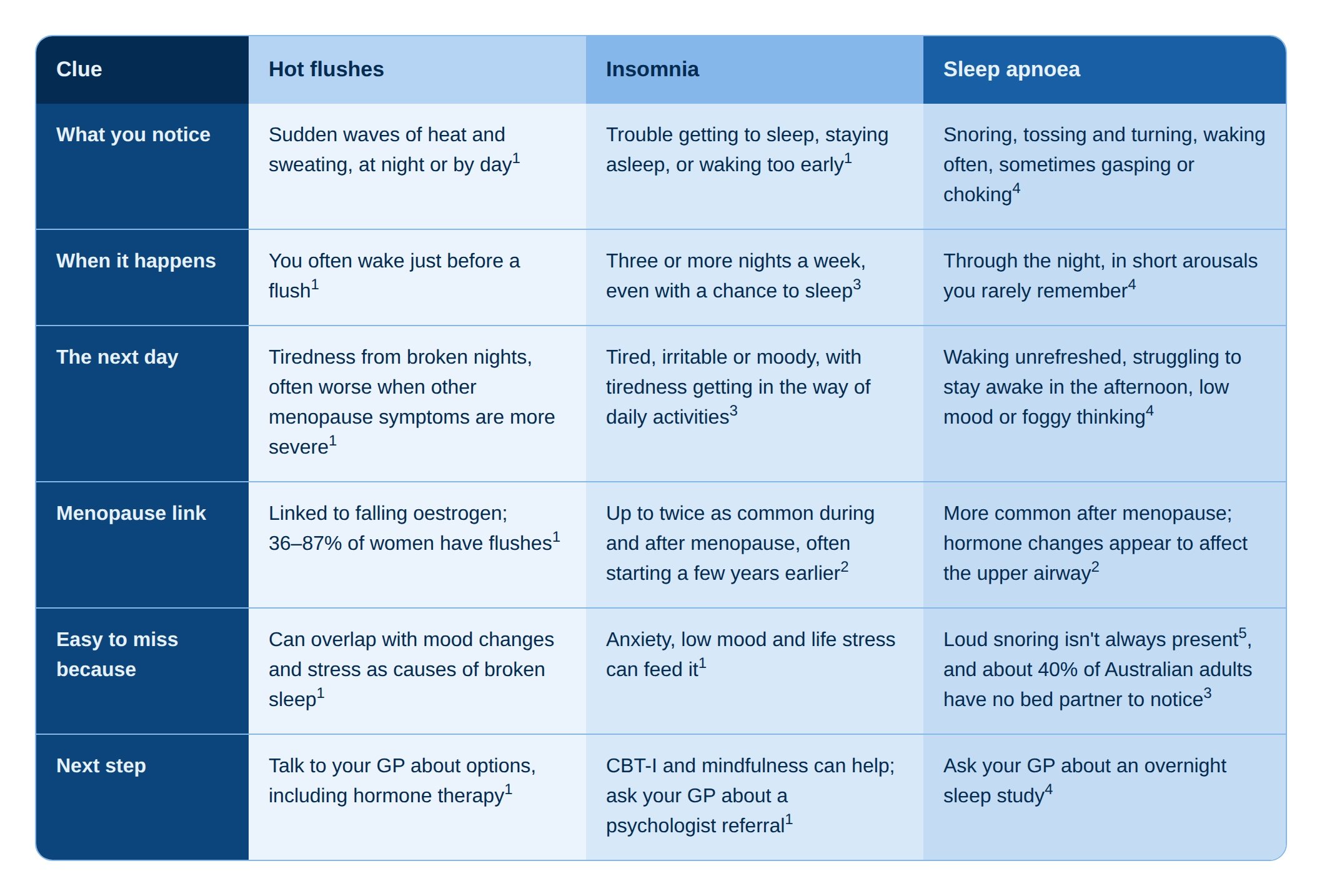
The clues overlap, and you can have all three. An overnight sleep study is the best way to be sure about sleep apnoea⁴.
A word of caution on alcohol, sleeping tablets and natural sleep aids
Alcohol and sleeping tablets relax the muscles and may make sleep apnoea worse in some people⁴. Natural products need some care too. About 40% of people use complementary medicines at least occasionally, and some turn to herbal remedies because they are wary of sleeping pills⁶. The most studied herbs are valerian, kava, hops, chamomile and passionflower, but there is little convincing evidence that they improve sleep⁶. Herbal medicines are generally considered safe for people with insomnia, but there are exceptions⁶. Some kava users have developed serious problems such as liver damage, and kava may not be safe to take with benzodiazepine-type sleeping tablets⁶. Hops has been linked to allergic skin reactions and respiratory problems⁶.
Melatonin is a hormone rather than a herb. It can cause sleepiness, and the Sleep Health Foundation advises talking to a doctor about when and how much to take⁷. It says long-term use is only appropriate if prescribed for a significant underlying sleep disorder⁷. In Australia, melatonin tablets need a prescription for people under 55⁷.
None of these products treat sleep apnoea, and relying on them could delay finding out whether it's the real problem. If you have been using any of them, or alcohol or sleeping tablets, to cope with poor sleep and you also snore, discuss it with your GP or pharmacist, including what you take and how often.
Treating each piece
Hot flushes and hormones. The Australasian Menopause Society says menopausal hormone therapy can markedly improve sleep quality in women with hot flushes¹. A meta-analysis summarised by the International Menopause Society found that hormone therapy improved self-reported sleep quality but not sleep measured in a laboratory, and that combined oestrogen and progestogen therapy improved sleep while oestrogen alone did not⁸. Hormone therapy may offer some protection against sleep apnoea, but studies so far haven't shown that it reliably treats it, so it shouldn't replace a sleep study and proper treatment⁹˒¹⁰.
Insomnia. Cognitive behavioural therapy for insomnia (CBT-I) and mindfulness training have been shown to improve sleep during the menopause transition¹. A randomised trial tested telephone-delivered CBT-I in perimenopausal and postmenopausal women with hot flushes¹¹. A referral from your GP with a mental health care plan allows a Medicare rebate for psychology sessions¹. CBT-I can also help when insomnia and sleep apnoea occur together⁴. In an Australian randomised trial of people with both conditions, CBT-I was effective even when sleep apnoea was severe¹². It treats the insomnia rather than the breathing problem, though, so a sleep study is still worthwhile.
Sleep apnoea. Your GP can refer you for a sleep study⁴. The two most commonly used treatments for moderate to severe sleep apnoea are CPAP and an oral appliance⁴. The Australasian Sleep Association supports custom splints for mild to moderate sleep apnoea, and for moderate to severe sleep apnoea when CPAP has not worked or cannot be tolerated¹³.
What actually helps
The approaches with the best evidence behind them are the ones above. They are hormone therapy where hot flushes are driving the broken sleep¹, CBT-I and mindfulness for insomnia¹, and a sleep study followed by CPAP or a mandibular advancement splint if sleep apnoea is involved⁴˒¹³. Each targets a specific cause, which is why working out the cause matters more than trying products one at a time.
Because more than one cause is often involved, the most useful first step is a conversation with a doctor who knows menopause. Your GP or a women's health doctor can look at all the contributing factors and build a plan around them¹. A doctor quoted by Jean Hailes suggests asking, "Do you specialise in menopause care?" and "What treatment options are there for my menopausal symptoms?"¹⁴. The same article advises finding a doctor who is confident in menopause care if yours is not¹⁴. The Australasian Menopause Society keeps a directory of member doctors and other health professionals with a special interest in midlife and menopause, which you can search by name and location¹⁵. The Australian Government notes that Medicare rebates are available to help make menopause care more affordable¹⁵.
Whoever you see, mention your snoring or any pauses in breathing, and ask whether a sleep study makes sense. Sleep studies are readily accessible. Your GP can refer you for one⁴, or the team at SleepWise can also organise one for you without a referral. If you would like to check your risk first, take our free online sleep apnoea test, or call SleepWise Clinic on 1300 101 505.
ReferencesSleep Health Foundation. Menopause and sleep [fact sheet]. Updated 9 February 2026. https://www.sleephealthfoundation.org.au/sleep-topics/menopause-and-sleepAustralasian Menopause Society. Menopause and sleep [information sheet]. https://www.menopause.org.au/hp/information-sheets/sleep-disturbance-and-the-menopause2Appleton, S. L., Gill, T. K., Lang, C. J., Taylor, A. W., McEvoy, R. D., Stocks, N. P., González-Chica, D. A., & Adams, R. J. (2018). Prevalence and comorbidity of sleep conditions in Australian adults: 2016 Sleep Health Foundation national survey. Sleep health, 4(1), 13–19.Sleep Health Foundation. Obstructive sleep apnoea (OSA) [fact sheet]. https://www.sleephealthfoundation.org.au/sleep-disorders/obstructive-sleep-apnoeaInternational Menopause Society. Menopause and Insomnia. https://www.menopauseinfo.org/wp-content/uploads/2023/09/IMS-Factsheet-11-sleep.pdfSleep Health Foundation. Herbal remedies and sleep [fact sheet]. 12 January 2024. https://www.sleephealthfoundation.org.au/sleep-topics/herbal-remedies-and-sleepSleep Health Foundation. Melatonin [fact sheet]. 26 August 2024. https://www.sleephealthfoundation.org.au/sleep-disorders/melatoninInternational Menopause Society. Can menopausal hormone therapy improve quality of sleep? 2022. https://www.imsociety.org/2022/06/15/can-menopausal-hormone-therapy-improve-quality-of-sleep/Shahar, E., Redline, S., Young, T., Boland, L. L., Baldwin, C. M., Nieto, F. J., O'Connor, G. T., Rapoport, D. M., & Robbins, J. A. (2003). Hormone replacement therapy and sleep-disordered breathing. American journal of respiratory and critical care medicine, 167(9), 1186–1192.Polo-Kantola, P., Rauhala, E., Helenius, H., Erkkola, R., Irjala, K., & Polo, O. (2003). Breathing during sleep in menopause: a randomized, controlled, crossover trial with estrogen therapy. Obstetrics and gynecology, 102(1), 68–75.McCurry, S. M., Guthrie, K. A., Morin, C. M., Woods, N. F., Landis, C. A., Ensrud, K. E., Larson, J. C., Joffe, H., Cohen, L. S., Hunt, J. R., Newton, K. M., Otte, J. L., Reed, S. D., Sternfeld, B., Tinker, L. F., & LaCroix, A. Z. (2016). Telephone-Based Cognitive Behavioral Therapy for Insomnia in Perimenopausal and Postmenopausal Women With Vasomotor Symptoms: A MsFLASH Randomized Clinical Trial. JAMA internal medicine, 176(7), 913–920.Sweetman, A., Lechat, B., Catcheside, P. G., Smith, S., Antic, N. A., O'Grady, A., Dunn, N., McEvoy, R. D., & Lack, L. (2021). Polysomnographic predictors of treatment response to cognitive behavioral therapy for insomnia in participants with co-morbid insomnia and sleep apnea: Secondary analysis of a randomized controlled trial. Frontiers in psychology, 12, 676763.Australasian Sleep Association. The use of oral appliances in the treatment of snoring and obstructive sleep apnoea: a position paper. https://www.sleep.org.au/common/Uploaded%20files/Public%20Files/ASA%20Membership/Guidelines/OA%20Position%20paper.pdfJean Hailes for Women's Health. How to talk to your doctor about menopause. https://www.jeanhailes.org.au/articles/how-to-talk-to-your-doctor-about-the-hormonal-changes-of-menopause/Australian Government. Perimenopause and menopause: find a doctor (includes the Australasian Menopause Society Practitioner Directory). https://www.health.gov.au/perimenopause/management-and-support/find-a-doctor